
⚡🔌Charging Problems? Signs Your Phone’s Charging Port May Be Failing
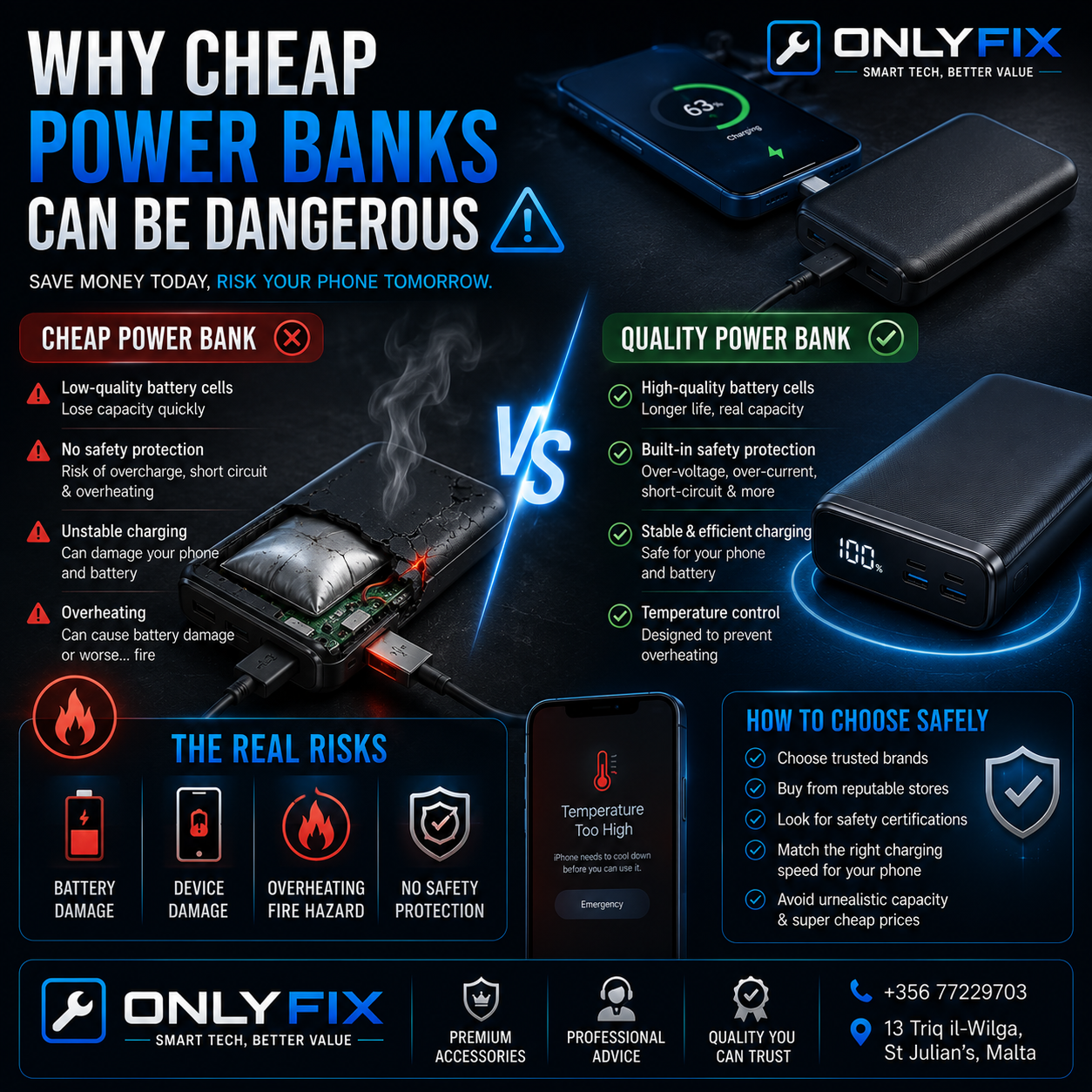
In today’s world, our smartphones have become essential. We use them for work, navigation, banking, photography, entertainment, and staying connected with family and friends. When the battery starts running low, a power bank is often the quickest solution.
But here’s something many people don’t realize:
Not all power banks are created equal.
A low-quality or counterfeit power bank may save you money initially, but it could end up damaging your smartphone—or even becoming a safety hazard.
Let’s take a closer look at why choosing a quality power bank is so important.
⚠️ The Hidden Risk Behind Cheap Power Banks
At first glance, two power banks may look almost identical.
They may even advertise the same battery capacity, charging speed, and compatibility.
However, what really matters is what’s inside.
Premium power banks contain advanced electronic circuits designed to regulate voltage, current, and temperature throughout the charging process.
Cheaper models often use low-quality batteries and simplified circuitry that may not provide the same level of protection.
As a result, your smartphone may receive unstable power, which can affect both performance and long-term battery health.
🔋 Poor Quality Batteries Can Wear Out Faster
One of the biggest differences between premium and cheap power banks is the quality of the battery cells.
Low-cost products often use recycled or lower-grade lithium cells.
These batteries usually:
• Lose capacity much faster
• Take longer to recharge
• Deliver less power than advertised
• Generate more heat during use
A power bank labelled as 20,000mAh may actually provide significantly less usable capacity than expected.
🌡 Heat Is Your Phone’s Worst Enemy
Excessive heat is one of the main causes of battery ageing.
When a poor-quality power bank overheats during charging, it can also increase the temperature of your smartphone.
Over time, repeated exposure to high temperatures may contribute to:
• Faster battery degradation
• Reduced charging efficiency
• Unexpected shutdowns
• Lower overall battery lifespan
This doesn’t necessarily happen after one use, but repeated charging with unreliable accessories can have long-term effects.
⚡ Fast Charging Isn’t Always Safe
Many inexpensive power banks advertise:
“22.5W Fast Charge”
“30W Super Fast”
“PD Compatible”
However, simply printing these specifications on the packaging doesn’t guarantee consistent performance.
Reliable manufacturers include intelligent charging chips that communicate with your phone to deliver the correct amount of power.
Without proper regulation, charging may become inconsistent, slower than expected, or place unnecessary stress on your device.
🛡 Built-In Protection Makes All the Difference
A quality power bank includes multiple safety systems designed to protect both the charger and your smartphone.
These protections commonly include:
✅ Over-voltage protection
✅ Over-current protection
✅ Short-circuit protection
✅ Overheating protection
✅ Overcharge protection
Without these safety features, the risk of damaging electronic components increases significantly.
💼 How to Choose the Right Power Bank
Before buying a power bank, consider these simple tips:
✔ Choose trusted brands.
✔ Buy from reputable retailers.
✔ Look for certified safety standards.
✔ Check that it supports your phone’s charging protocol.
✔ Avoid products with unrealistic battery capacities or unusually low prices.
Remember, your smartphone is often worth hundreds—or even thousands—of euros.
Protecting it with a reliable charging accessory is a smart investment.
📱 Final Thoughts
A power bank should give you peace of mind, not create new problems.
While cheap models may seem like a bargain, the hidden risks of poor battery quality, overheating, unstable charging, and lack of protection can cost far more than the money you initially saved.
At ONLYFIX, we carefully select quality accessories that are designed to work safely with today’s smartphones, helping our customers protect both their devices and their investment.
If you’re unsure which power bank is right for your phone, we’re always happy to help you choose the best solution.
📍 ONLYFIX – SMART TECH, BETTER VALUE
🔋 Premium Power Banks
⚡ Fast Chargers
📱 Smartphone Accessories
🔧 Professional Repairs
📞 +356 77229703
📍 13 Triq il-Wilga, St Julian’s, Malta
power bank Malta, premium power bank, phone accessories Malta, smartphone accessories, fast charging, USB-C power bank, portable charger, iPhone charger Malta, Samsung charger, safe power bank, phone battery health, charging accessories, mobile accessories Malta, smartphone repair Malta, ONLYFIX Malta, St Julian’s phone repair, portable battery charger, USB-C PD charger, quality phone accessories, phone shop Malta

0 Comments